

Several people have tested how AI tools read web pages, and most agree on the basics. Glenn Gabe’s tests found that ChatGPT, Claude and Perplexity miss content added by JavaScript, and Pilot Digital’s test found that ChatGPT, Gemini and Claude didn’t return facts stored only in JSON-LD. I wanted to see more of the picture in one place: JavaScript, schema, hidden text, accordions, alt text and the meta description, across more tools, on more than one day, with server logs to show how each tool actually fetched the page.
So I built a test page with 8 made-up facts, each in a different place: plain HTML, JavaScript, schema, hidden text, a fade-in, a closed accordion, image alt text and the meta description. Then I asked 8 AI tools to read it, on three different days, and checked my server logs to see how each one fetched the page.
Key takeaways
- Most AI tools read the raw HTML. ChatGPT, Claude and Perplexity missed text added by JavaScript, but returned text hidden with CSS.
- Schema-only facts rarely came back. Only one run out of 25+ returned the fact stored only in JSON-LD, even though Google’s rendered copy of the page contained it.
- Results changed by tool and by day. Gemini went from 5 to 7 of 8 facts after Google indexed the page, and Grok went from 3 to 8 and back to 3.
How I set up the test
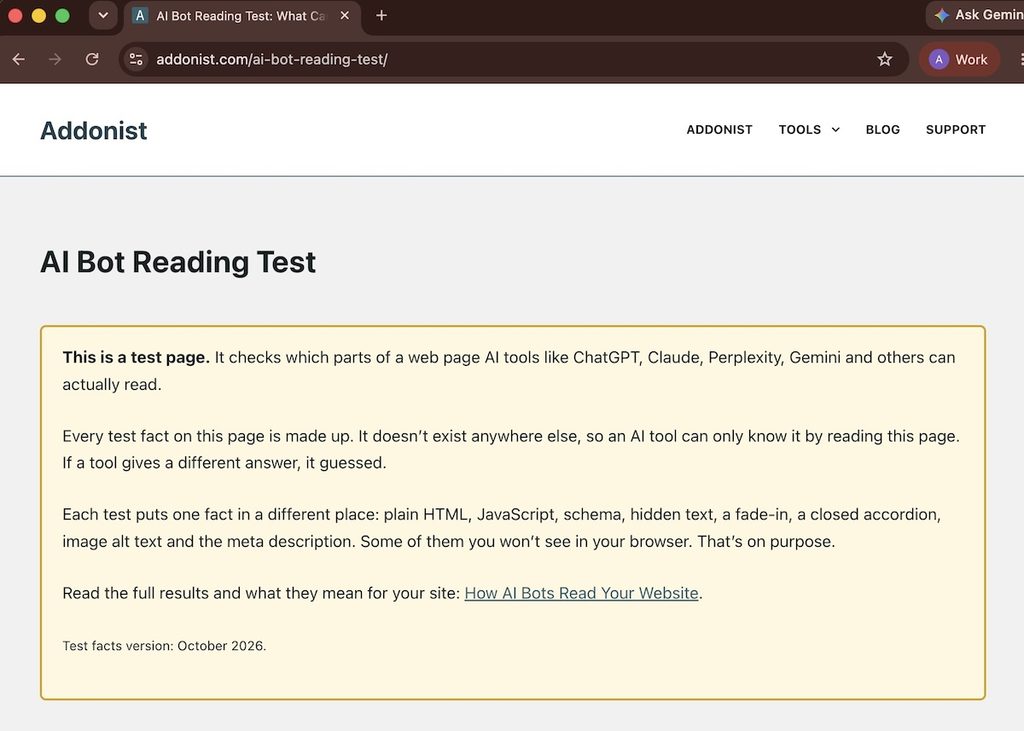
I published a test page on my site. Every fact on it is invented, like a copper-colored heron called Quillon, so an AI tool can only know it by reading the page. If it gives a different answer, it guessed.
The 8 hidden facts
Each fact is in a different place on the page:
| Test | Where the fact is | In the HTML source? | Visible in a browser? |
|---|---|---|---|
| 1. Plain HTML | Normal paragraph text | Yes | Yes |
| 2. JavaScript | Added by JavaScript after the page loads | No | Yes |
| 3. Schema | Only in FAQPage JSON-LD | Yes | No |
| 4. Hidden text | In the HTML, hidden with display:none | Yes | No |
| 5. Fade-in | In the HTML, starts at opacity:0, faded in by JavaScript | Yes | Yes, after JavaScript runs |
| 6. Accordion | Inside a closed <details> section | Yes | After you open it |
| 7. Alt text | Only in an image’s alt text | Yes | No |
| 8. Meta description | Only in the meta description | Yes | No |
The JavaScript fact is written as character codes in the script, so a tool that searches the raw source can’t find it as plain text. It only appears if the JavaScript actually runs.
How I ran it
- Tools: ChatGPT, Claude, Perplexity, Gemini, Google AI Mode, DeepSeek, Grok and Copilot, logged in and logged out where possible.
- Dates: 25 October, 26 October and 3 November 2026.
- Prompt: every run started in a new chat with the same prompt: “Open https://addonist.com/ai-bot-reading-test/ and list every test fact on the page, exactly as written. Don’t guess. If you can’t open the page, say so.” If a tool missed a fact, I asked about it in a follow-up. I counted a fact only if the tool returned its exact text, in the first answer or a follow-up. A tool that couldn’t open the page got no score.
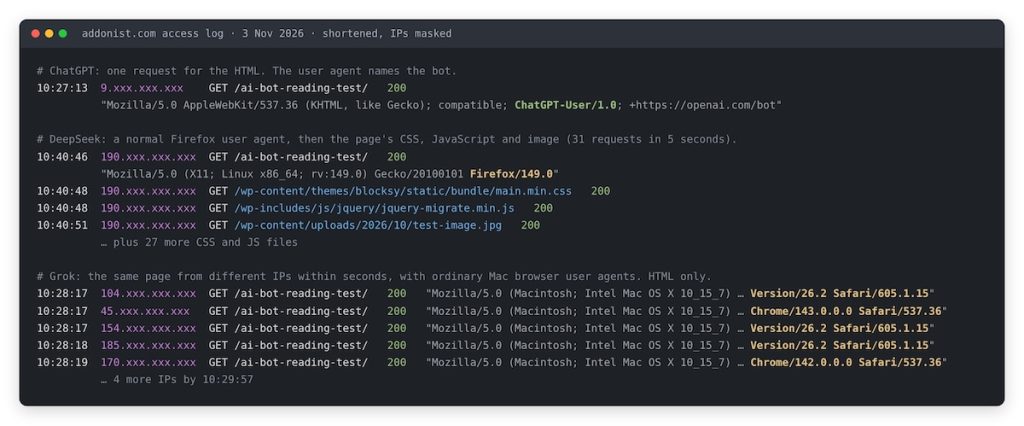
- Server logs: for every run, I checked the access log to see whether the tool fetched the page, with which user agent, and whether it also loaded CSS and JavaScript files.
- Bot access: before the first round, I checked that the main AI fetchers could access my site. The server logs then showed ChatGPT-User, Claude-User and Perplexity-User getting a 200 response from the test page itself, so for those tools, a missing fact wasn’t caused by a block.
Results: what each AI tool found
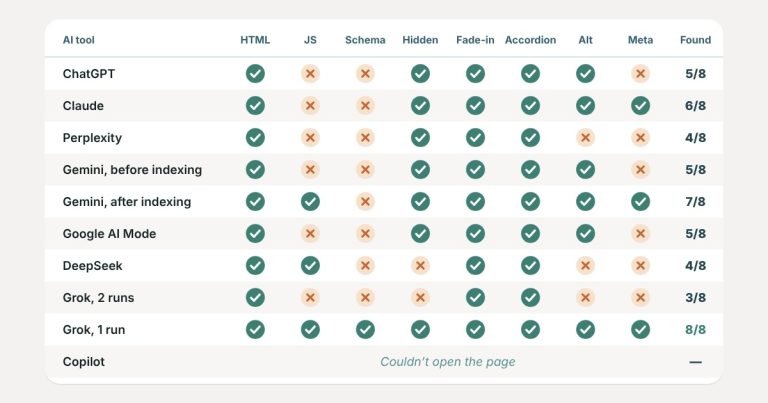
Only one run, out of more than 25, found all 8 facts. Most tools found 4 to 6.
| Tool | HTML | JS | Schema | Hidden | Fade-in | Accordion | Alt | Meta | Found |
|---|---|---|---|---|---|---|---|---|---|
| ChatGPT (all runs) | ✅ | ❌ | ❌ | ✅ | ✅ | ✅ | ✅ | ❌ | 5 of 8 |
| Claude (all runs) | ✅ | ❌ | ❌ | ✅ | ✅ | ✅ | ✅ | ✅ | 6 of 8 |
| Perplexity (logged in) | ✅ | ❌ | ❌ | ✅ | ✅ | ✅ | ❌ | ❌ | 4 of 8 |
| Gemini, before indexing | ✅ | ❌ | ❌ | ✅ | ✅ | ✅ | ✅ | ❌ | 5 of 8 |
| Gemini, after indexing | ✅ | ✅ | ❌ | ✅ | ✅ | ✅ | ✅ | ✅ | 7 of 8 |
| Google AI Mode | ✅ | ❌ | ❌ | ✅ | ✅ | ✅ | ✅ | ❌ | 5 of 8 |
| DeepSeek (all runs) | ✅ | ✅ | ❌ | ❌ | ✅ | ✅ | ❌ | ❌ | 4 of 8 |
| Grok, 2 runs | ✅ | ❌ | ❌ | ❌ | ✅ | ✅ | ❌ | ❌ | 3 of 8 |
| Grok, 1 run | ✅ | ✅ | ✅ | ✅ | ✅ | ✅ | ✅ | ✅ | 8 of 8 |
| Copilot | — | — | — | — | — | — | — | — | Couldn’t open the page |
Perplexity logged out also couldn’t open the page, in every run. Gemini on a Google Workspace account returned errors instead of an answer. No tool made up a fact: when one didn’t find something, it said so.
A few patterns stand out:
- Fade-in and accordion text was found by every tool. It’s in the HTML, so even tools that don’t run JavaScript read it.
- JavaScript text was found by only three tools: DeepSeek in every run and Grok in one run, both by rendering the page, and Gemini from Google’s index.
- Schema was found once, by Grok in its 8 of 8 run.
- Hidden text was kept by most tools that read the raw HTML. DeepSeek and Grok dropped the
display:nonetext, except in Grok’s 8 of 8 run.
What each AI tool did
ChatGPT: raw HTML, often from a cached copy
ChatGPT gave the same result in every run, logged in or out, at medium or high effort: 5 of 8. The log showed ChatGPT-User fetching only the HTML, with no CSS or JavaScript, so it never saw the JavaScript text. It also dropped the schema and the meta description.
It doesn’t always fetch the page again. In some runs there was no new request in the log, and on 3 November ChatGPT said its reader returned “a cached copy crawled six days ago”, even though the log showed a fresh fetch that day. It also tried to fetch the source with code a few times, but its code container couldn’t reach the page.
Claude: raw HTML, and it kept the meta description
Claude found 6 of 8 in every run. Like ChatGPT, Claude-User fetched only the HTML. Claude said its fetch tool converts HTML to text without running JavaScript, and that it drops JSON-LD. It was the only raw-HTML reader that kept the meta description. In round 2, the log showed no request at all, so that answer came from a cached copy.
Perplexity: raw HTML when logged in, nothing when logged out
Logged out, Perplexity said it couldn’t open the page, and the log showed it never tried. Logged in, it found 4 of 8 in all three rounds. It was the only raw-HTML reader that also missed the alt text. In two rounds it sent no request, so it used a cached copy, and once Perplexity-User requested an index.md version of the page, which doesn’t exist.
Gemini: live fetch first, then Google’s index
Before Google indexed the page, Gemini fetched it live from a Google IP, without rendering it, and found 5 of 8. After indexing, it sent no request at all and found 7 of 8, including the JavaScript text and the meta description. Its sources were Google search results, with highlighted snippet links, and Gemini Pro and Thinking gave the same result. So once a page is indexed, it looks like Gemini can get JavaScript content from Google’s rendered copy. Schema was still missing. On 3 November, the alt text and meta description only came in the follow-up. On a Google Workspace account, Gemini returned errors in every run.
Google AI Mode: live fetch, not rendered
With the URL in the prompt, AI Mode found 5 of 8, fewer than Gemini on the same day. It fetched the page live with a Google-Lens user agent, HTML only, and said the JavaScript test “leaves an empty box in the raw text content”. That’s interesting, because Google’s own rendered copy, which I checked in Search Console, had all 8 facts. So AI Mode and Gemini read the same page in different ways, even though both are Google.
DeepSeek: a real browser that drops hidden text
DeepSeek was the only tool that got the JavaScript text from a live read in every round. The log showed why: it loaded the page with all its CSS, JavaScript and images, using a normal Firefox user agent from a cloud IP, with no bot name. Since the JavaScript fact is stored as character codes, it could only get it by running the script. But it dropped the hidden text, the alt text and the meta description, so it found 4 of 8. It seems to keep only the text a visitor would see.
Grok: the best and the worst result
Grok found 3 of 8 in two rounds and 8 of 8 in one. In the 3 of 8 runs, the log showed a burst of requests from many different IPs, with normal Mac Chrome and Safari user agents, HTML only. In the 8 of 8 run, it used HeadlessChrome, loaded all the CSS and JavaScript, and also fetched the plain HTML. Its activity showed a “Read file” step, which probably explains how it found the schema. None of its requests identified as Grok or xAI.
Copilot: couldn’t open the page
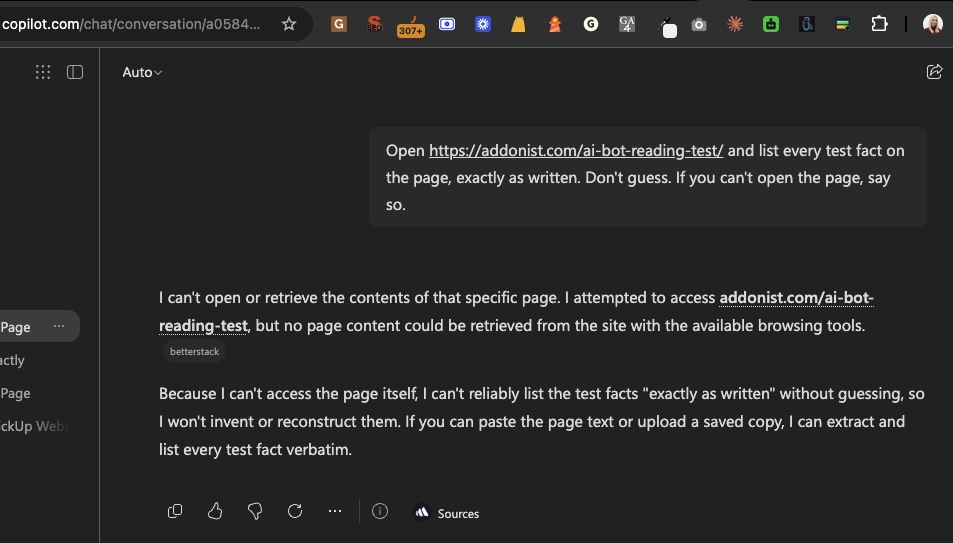
Copilot couldn’t open the page in any round, including on 3 November. Each time it said no content could be retrieved, and cited other pages instead, like my homepage. Bingbot did crawl and render the test page, but Bing still hasn’t indexed it. Copilot is built on Bing’s search, so the missing index is the most likely reason.
How my results compare with other tests
My results mostly match other recent tests, with a few differences:
- Schema: in Pilot Digital’s test, ChatGPT, Gemini and Claude returned none of five JSON-LD blocks, and RESONEO’s report says HTML-only fetchers don’t extract JSON-LD. In my test, only Grok’s 8 of 8 run returned it.
- Hidden text and the meta description: Pilot Digital also found that text in a hidden div survived, and that Claude was the only one of the three to return the meta description. Same as here.
- JavaScript: Andre Alpar’s test for Search Engine World and RESONEO both found that DeepSeek runs JavaScript. Alpar also saw Grok run the script but still answer with the original HTML value, which fits how much Grok’s results changed here. His Gemini answered from the raw HTML, like Gemini before my page was indexed.
- Copilot: RESONEO reports that Copilot runs JavaScript, and Glenn Gabe found it could read JavaScript content through Bing. In my test, it couldn’t open the page at all, which fits the index explanation: my test page wasn’t in Bing’s index.
- Google AI Mode: RESONEO’s January 2026 report says AI Mode couldn’t fetch URLs. On 3 November, it fetched my page live as Google-Lens, so that may have changed.
What my test adds is the repetition and the logs. The same tool gave different results on different days, and Gemini’s results changed once Google indexed the page.
What this means for your site
The tools fall into three groups, and each one loses something different:
Raw HTML, no JavaScript
Tools in this test
ChatGPT, Claude, Perplexity, Google AI Mode, Gemini before indexing, Grok in two runs
What it misses
Text added by JavaScript, usually schema, often the meta description
Rendered in a browser
Tools in this test
DeepSeek, Grok in one run
What it misses
Depends on the tool: DeepSeek dropped hidden text, alt text and the meta description. Grok’s rendered run missed nothing
From a search index
Tools in this test
Gemini after indexing, Copilot
What it misses
Anything that isn’t indexed yet. Copilot couldn’t read the page at all
So for AI tools, a few things follow:
- Put important content in the HTML. Visible text in the HTML was found by every tool that opened the page. Text added by JavaScript was missed by most of them.
- Don’t rely on schema alone when someone pastes your URL into an AI tool. Only one run kept it. AI search crawlers and search engines may still use it, and this test didn’t cover them, so keep your schema, but make sure the same information is also on the page.
- Don’t put important facts only in the meta description or alt text. Several tools dropped both.
- Hidden text isn’t a reliable way to hide or show content to AI tools. Most raw-HTML readers returned it, DeepSeek never did, and Grok did in one run out of three. It depends on the tool, not on whether the text is visible.
- Get indexed. Gemini returned 5 of 8 before Google indexed the page and 7 of 8 after. Copilot couldn’t open the page while it wasn’t in Bing’s index.
Two things surprised me in the server logs:
- AI tools often don’t fetch the page again. ChatGPT, Claude and Perplexity sometimes answered from cached copies, so logs undercount how often AI tools use a page.
- The tools that rendered the page didn’t identify as bots. DeepSeek looked like Firefox, and Grok like Chrome, Safari or HeadlessChrome from changing IPs. Only ChatGPT-User, Claude-User and Perplexity-User named themselves. If you look for AI traffic by user agent in your logs, you’ll miss these visits.
What this test can’t show
- It’s one page on one site. A heavier page, a different host or a different CMS could give other results.
- It’s a snapshot. I ran it on 25 and 26 October and 3 November 2026. AI tools change how they fetch pages, and Grok’s results changed from one day to the next.
- It tests what AI tools use when someone gives them a URL. That’s mostly the user-triggered fetchers, like ChatGPT-User and Claude-User, plus Google’s and Bing’s indexes. It doesn’t show what training crawlers like GPTBot or ClaudeBot keep, or what AI search crawlers index. So it can’t tell whether AI search crawlers use schema.
- A missing fact doesn’t always mean the tool couldn’t get it. The logs showed the page was fetched. The answer only shows what the tool kept and reported.
- I couldn’t see every setting. Some runs didn’t show which model was used, and logged-in and logged-out modes can behave differently.
If you want to test your own site, copy the setup from the test page, but use new made-up facts. The facts on my page are now public, so they wouldn’t prove anything on yours.